This is my impression alone; hundreds of others who were there that day have their own stories to tell. Please do!
9:10 AM. Just as Steven Spielberg prepped the clown-sized scissors to cut the ribbon and officially open Universal Studios Florida, my radio squawked: I was needed somewhere else in the park to talk with a reporter.
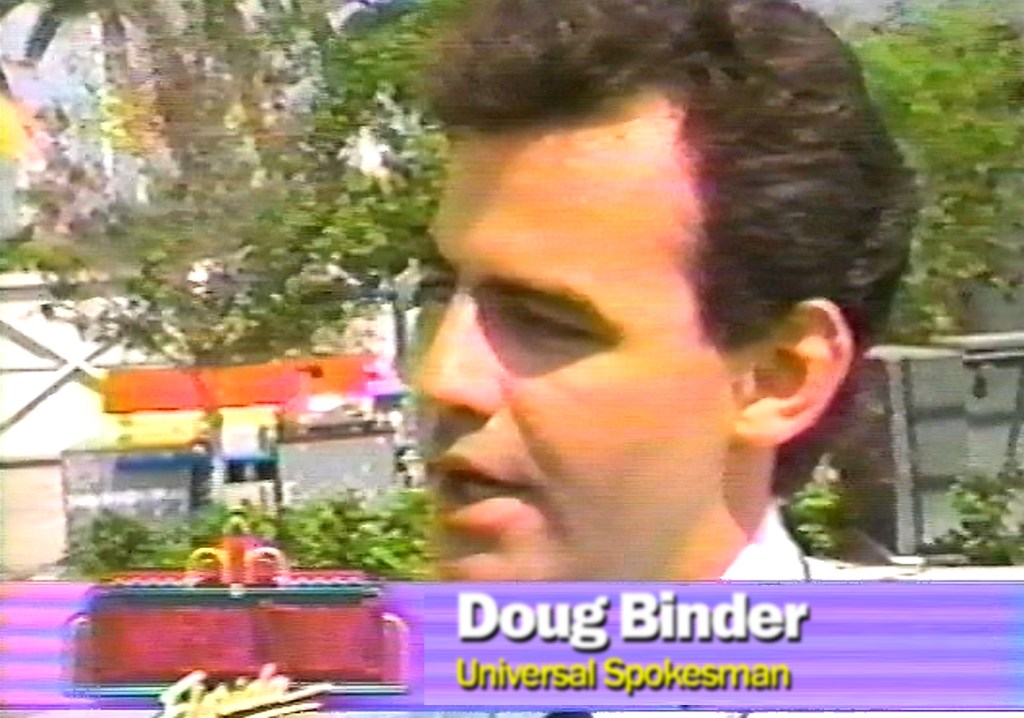
9:15 AM. Natalie Allen from the local CBS affiliate held her microphone to my face and asked me to comment on the situation. I gushed about all the celebrities, the celebrations, the impact of hosting the international press in Central Florida.
9:18 AM. Natalie clarified that the situation was that none of the rides were working and crowds were upset, demanding refunds. What was my response? “A minute, please.”
9:20 AM. I stepped away to a house phone and called the command center to ask for an update on the rides. On a scrap of paper I scribbled down a list of the current situation: Jaws NO. Kong NO. Earthquake NO. E.T. YES. The operator continued with the lesser bits of other attractions; I thanked them and hung up. This was going to be a bad day.
9:23 AM. I returned to Natalie’s camera and delivered (copped to) the grim scenario. Even then, I was able to recite the bleak details with the most positive spin I could muster. The most positive spin anyone could muster. My bosses were watching from a distance as it sunk in with all of us.
So began a day and a summer that would live in theme park infamy. It was a hot and humid Thursday. The park was crowded with first-day revelers who were becoming increasingly chaotic. They. Were. Pissed. Management in suits removed their ties and name tags. I heard that one senior executive, surrounded by angry guests demanding refunds, took a wad of bills from his pocket and started throwing money into the air in order to escape.
The global media was not sympathetic. They captured and shared footage of guests screaming into the cameras, demanding an explanation and certainly their money back. One even caught an argument between an unhappy guest and Tom Williams, the company GM at the time, and Tom was not winning. All morning I ran from interview to interview trying to keep a positive vibe; I had nothing else to work with.
I am writing portions of this on May 21, after watching four hours of NBC TODAY programming live from the opening of Universal’s latest park EPIC. The hosts — journalists, presenters and influencers — piled on rave reviews of the place, as though there was no other news to report today anywhere in the world. As proud as I am of colleagues who made EPIC happen, the broadcast was downright cringey. But to a publicist, this is GOLD! PLATINUM. Too bad we didn’t have such craven journalistic standards and corporate synergy back in the day.
A little backstory
I was 25 and had been in publicity at Universal for a little over a year, having defected from PR at Walt Disney World. Way back then, only the “Psycho” house and the sound stages existed. I spent the first few months driving around the oft-muddy construction site in my Honda Civic to meet up with reporters and tour celebrities. Tours usually began in the model room where a sprawling scale model of the park was built. It was cool.
My first official act was to produce the groundbreaking of Nickelodeon Studios: a half dozen execs with shovels pitched into the ground to unleash a geyser of green slime, the brainchild of my boss Rod Caborn and a big success on the wires.
The marketing department rolled out a major-market media tour in the summer of 1989, produced by Doug Trueblood, several agencies and others. I clocked a lot of USAir miles, hitting one or two different cities each week, giving tours of the traveling model and organizing interviews for execs. Then one day, I was told that I would be going to a radio studio to speak live on-air for an hour with Denny McLain, a former Tigers pitcher and a controversial Detroit mainstay. I guess I did okay because then I got to play spokesperson a lot more. And I liked it.
In time, I was told that Universal chairman Lew Wasserman liked the work I was doing; I was given the department’s only cell phone in order to be the first line for press inquiries. It was a brick. The first month I had it, I ran up a bill of $200 (probably 20 minutes of talk time back then), mostly calling my colleague and roommate Matt Palmer to brag that I had a cell phone and he didn’t. CMO Randy Garfield quickly brought me in line.
We executed a lot of publicity stunts in the pre-opening year, on the road and at home. Some were clever, some not. The most humiliating was when we launched a partnership with USAir. The idea was that costumed characters Fred Flintstone and Barney Rubble would board a flight at LaGuardia and then deplane at the Orlando airport. I was assigned to be their handler and mouthpiece on the Orlando end. Long and short: there was no press, no purpose, but I think there was a marching band. Oh, and the sight of my boss Eileen Harrell laughing her ass off and hiding behind a pillar.
That’s the thing about publicity
You have to believe in the role, no matter the situation, its plausibility or absurdity. I did, or at least I made myself believe I did. During construction, it was easy and kinda fun to regale reporters with breathless tales of how cool the rides would be, how different from Disney the experience would be, and how mind-blowingly awesome the grand opening would be.
I was young, impressionable and merely a vessel for ingesting the information I was being fed by some important people and then broadcasting it out with the flair of a silver-tongued English major. Was I doing my own research to confirm any of it? Nope. I believed.
Given this experience, I can relate to others in the role of spokespersons, especially in government. They are told what to believe, they want to believe it, their job is to broadcast it out as truth. Their role is to believe and make others believe no matter what their own values and ethics are. To succeed at the job, one needs to dismiss the inconsistencies and hypocrisies and do what the good book tells you. As we’ve learned in recent years, if you repeat a fallacy enough times it becomes truth to some.
And frankly, when it comes to making assertions and speculations, you can’t prove me wrong. Until you can.
The truth will win out
When the big day finally came, I was at the park at four in the morning, pure adrenaline coursing through my veins. I, along with Matt and others, were doing hits with radio and TV stations from all over the place, housed in the media center and throughout the park. I was laying it on thick, building anticipation for the day’s excitement and offering assurances for the stability of rides and attractions that I myself hadn’t even been able to experience. I was a believer.
It was already blistering hot at eight o’clock when thousands of invited guests gathered on Hollywood Boulevard facing a festive stage and a camera-ready backdrop of the park’s backlot scapes. Celebrities and dignitaries arrived in convertibles, like something out of a hometown parade. They took their places on stage, facing east into the roasting Florida sun. Speeches were made, a time capsule was packed and sealed, and niceties exchanged all around. It was a somewhat tortuous blend of ballyhoo and business, and I was into it.
The gates opened to the public at nine o’clock. The hordes were diverted to other areas of the park as Spielberg cut the ribbon.
Then the call came to meet up with CBS.
After 14 months of spinning, reality caught up to me. It caught up with everyone involved, including some of the park’s planning and production arm who had scoffed weeks earlier at having to undergo media training. “The rides will speak for themselves,” quipped one old-timer.
While I flailed for another six hours of interviews and briefings, management devised a rescue plan to appease guests and turn the story in a positive direction. By the time the predictable thunderstorms rolled through in mid-afternoon, the park had emptied and I was relieved of my duties. Tom Williams and park president Steve Lew said they’d take it from here. They invited me along as they visited all the broadcast stations lined up around the lagoon — local TV stations and a few bigger outlets. They delivered the news for the plan going forward. The park was eerily quiet and still.
That evening’s VIP party went on as planned. Everyone just wanted to celebrate the milestone we’d all worked so hard for and make all the hard work to come tomorrow’s problem. An 11 o’clock party had been planned for the marketing department at Finnegan’s Bar in the backlot. Hundreds of us gathered to commiserate, and then and Tom and Randy arrived. Given the events of the day, they said, it’s best to postpone the party for another time; go home and get some sleep.
Moving on
It was a brutal year for the park, at the turnstiles and in the press.
But all that changed in May of 1991, with the much anticipated premiere of Back to the Future: The Ride. A stellar attraction that soft-opened months early to ensure smooth operation and generate buzz. Best of all, I got to produce the opening event, under the guidance of the ride’s producer Terry Winnick and with clever design input from one of the park’s architects Mark Woodbury. This time, my buddy Matt Palmer — along with others — was playing spokesperson.
June 7 is a day that still reunites far-flung souls who were there and who remember, whose careers were altered and values challenged. In fact, 20 years later, a few hundred of us attended an unsanctioned gala at an offsite location to reminisce and continue to heal. 35 years later, it still echoes. One colleague, a veteran of Viet Nam, likened the unifying aspect to one of battle. That’s a stretch, but it helps a lot of us understand why June 7 forged such a lifelong bond.
Btw, the after-party was never rescheduled. And June 7 was never celebrated as an official anniversary for the park, at least not by the company. Only recently, with the opening of EPIC, have I seen footage from June 7, 1990 used in marketing, nurturing the narrative of Universal’s legacy in Florida.
Where are they now
- Tom Williams became Chairman and CEO of Universal’s global parks and resorts until retiring a few years ago
- Mark Woodbury took Tom’s place and continues to expand the brand around the world. He just opened his baby EPIC Universe
- Randy Garfield became president of Walt Disney Travel and retired a while back. We’re FB friends
- Terry Winnick worked on major projects in Las Vegas and passed away about ten years ago
- Doug Trueblood has been everywhere and now, of all places, Michigan
- Eileen Harrell lives in Florida. She was at the most recent annual Universal party last November
- Natalie Allen spent a decade anchoring CNN
- I saw Matt Palmer a few months ago. He became a muck a muck at Viacom, Disney and lots of start-ups. There’s more Matt to come in 60|60
As for the time capsule
All of the items “donated” at the grand opening by the likes of Michael J. Fox, Jimmy Stewart, Spielberg, Janet Leigh and Jane Seymour ended up under Matt’s and my desks in our cubicles in the publicity office. In a few weeks, it had all disappeared or been returned to sender. If the time ever comes to open the time capsule, it will be a major letdown. None of it was real.

 Binderama60for60
Leave a comment