My whole life I’ve hated death. I hated it because I didn’t understand it. I hated it because it scared me. I accepted that it was inevitable, but it was all the stuff that comes along with it that I couldn’t comprehend, I couldn’t cope with: the sadness and totality of the loss, the disposition of the corpse, the rituals and traditions, hearses and funeral homes and graveyards and grave diggers and lots of people crying.
For my first 45 years, death was distant. I never had grandfathers. My Gramma Essie passed in 1980 (on the same day as John Lennon, much to my Dad’s dismay). Gran died a few years later. I’ve written about it in this 60|60 series: she lived across from the funeral home and when I visited her as a kid she attended one or two services, getting dressed up, walking over and coming back to make lunch. When I was one of her pallbearers, I looked back at her house. Writing this just now, I thought I’d find a pithy angle to exploit here. Nope.
My First Biggie
For years I dreaded the phone call. My brother Tim was expected to be the source of any news about the Folks, him being the eldest. Whenever I’d see his name flash upon my phone at odd hours, I braced for the worst. It was always a false alarm–Tim would start by saying that everything’s fine. Until that time it wasn’t.
On a Sunday in May 2011, I made my weekly call to the Folks around lunchtime. Dad sounded weak and Mom sounded worried. Mary pointed out, rightly, that I had no job or prospects, so I should fly in to help out. I booked a flight for Lake Michigan to depart early Monday morning.
Just after midnight, my phone blew up: Tim. My defenses were down when I answered Tim’s call. “Doug [long pause] Dad is dead.” Tim’s low rolling voice added serious gravitas to an already tragic moment.
And with that, death was coming at me fast, for the first time.
Mom and I spent Tuesday shopping for caskets, choosing a monument and writing Dad’s obituary, as one does. My brothers arrived on Wednesday and we hashed out plans and argued with the gravediggers (chuckleheads, as I called them). Mary came Thursday. The cousins showed up, neighbors came, Dad made the front page of the newspaper, above the fold, and then we buried him on Friday.
His death in 2011 was the first big one for me. After the flurry of the funeral week, I stayed with Mom a while longer. Mom knew about death from an early age. Over the next few weeks, as I sat with her, I came to accept that death isn’t about the dead because; they’re no longer here. Death is about the living, the survivors, who grieve or celebrate or try to move on. With Dad’s death, I felt strangely wise and enlightened.
A survey from the society of funeral directors came in the mail asking Mom to rate the service of the place that handled Dad’s arrangements. I read the questions aloud and checked the boxes as Mom instructed. The last one was: Would you like to pre-plan your funeral arrangements? Mom dismissed it out of hand. Why, I asked. “I don’t care, I’m not going to be here,” she said. Huh, okay. She added, “Just get me what your Dad got.”
That was a revelation. To Mom, at that point, death was just another errand or chore to be addressed in the least disruptive way. Don’t make such a big deal.
And Then…
Four years later, I was awakened in a hotel room in Portland when a call came in from Tim’s phone. Oh God, I thought, Mom is dead! I answered, enthusiastic but steeled for the news. “Timbo!”
But it wasn’t Tim, it was his wife Gina. She talked fast and breathlessly, and I couldn’t really keep up. Something had happened to Tim, he was working out, garage, mouth-to-mouth, the taste of coffee, she was on her way to tell Mom, and soon enough I gleaned that Tim was dead. My mind reeled.
Two days after Tim’s Friday death, I was in Virginia to stay with Mom and help Gina with whatever needed doing for his celebration. We visited the funeral home. As we were finishing up in a conference room, the director asked if we’d like to view the body. My immediate reaction: No. But as we left that room, the door across the hall was ajar; I glimpsed Tim’s body on a table. Still I resisted. It was too scary. After a few minutes in the lobby waiting for Gina, I excused myself and went back to be with my dead brother. I needed to say something to him — to myself. I stayed for a few minutes, studying his color, the blue and gray streaks that appear after a body settles for a few days, the curious and familiar smirk on his face. And then I said goodbye. I couldn’t touch him.
A vision had come to me right after Gina called that morning. It was of Tim being reunited with Dad, dropping their lines from a rowboat on the surface of a foggy, celestial lake. Over the next few weeks it evolved with more clarity and color; maybe that was a part of my grieving process. For his birthday the following month, I shared this with Mom and Gina and had a high-end printer craft a few copies for framing. It’s called The Conversation and I look at it every day.

And the Hits Just Keep on Coming!
A few months before Tim’s death, Mary’s Mother passed after years suffering with Alzheimers. A few months after Tim, my dear Aunt Jeanne passed unexpectedly, and then her husband Uncle Larry a few months after that. With so many losses in a short period of time, my boss at first denied my last few time-off bereavement requests.
When Mary and I got married later that year, we included three lit candles on the altar. We decided not to assign them to any of our recent losses but rather to inspire our guests to ascribe their own meaning to ones they’d lost over the years, to honor the spirit of all who came (and went) before us.
Mom passed in 2020 during the pandemic. I was able to talk to her on the phone in her last minutes of life, thanks to my brother Mike and his wife Martha.
A year after that, Martha died after a short but mighty bout with cancer.
A Few Other Takeaways From All This Death
I wish someone had told me about how to handle death and the aftermath. But it’s better that they didn’t.
One important lesson I gleaned: everyone grieves differently. Some just accept the fated absurdity of it all, others feel a sense of relief, some older folks are pretty pragmatic about the whole thing. And of course there are those who are inconsolable for days or months or the rest of their lives. Do not attempt to advise how others should grieve; it’s insulting and can be hurtful.
The eeriest moment is when you enter the deceased’s place for the first time since they passed. Depending on the circumstance, everything is arranged as though they’ll be back any minute from an errand. Books on the nightstand, clothes in the hamper, a to-do list in the on the counter, food in the fridge, a loaded shotgun hidden behind a credenza in a law office (true story).
No one is truly dead until the government, banking institutions, lots of lawyers and even Facebook say so. The paperwork and red tape are infuriating. Make sure to request extra copies of death certificates, you’ll need them. And because the business of death is dense and many-layered, the callous indifference at every step is beyond frustrating. But it’s the law, I’m told, and everyone needs to get a piece of the action.
At one of the funerals during Death Year 2015, an older lady asked about Tim’s death. When I explained that it was a massive heart attack, she didn’t miss a beat: “Oh, that’s good.” I was gobsmacked at the time, but I’ve come to understand her sentiment, if not her enthusiasm.
Most of the deaths I’ve been close to are explainable in some way: diagnosed and undiagnosed maladies mostly. I cannot get my head around how it must feel for the loved ones of those who die in accidents and foul play. I’ve known folks who’ve gone through it, and it’s not something I’ve ever been able to discuss with them.
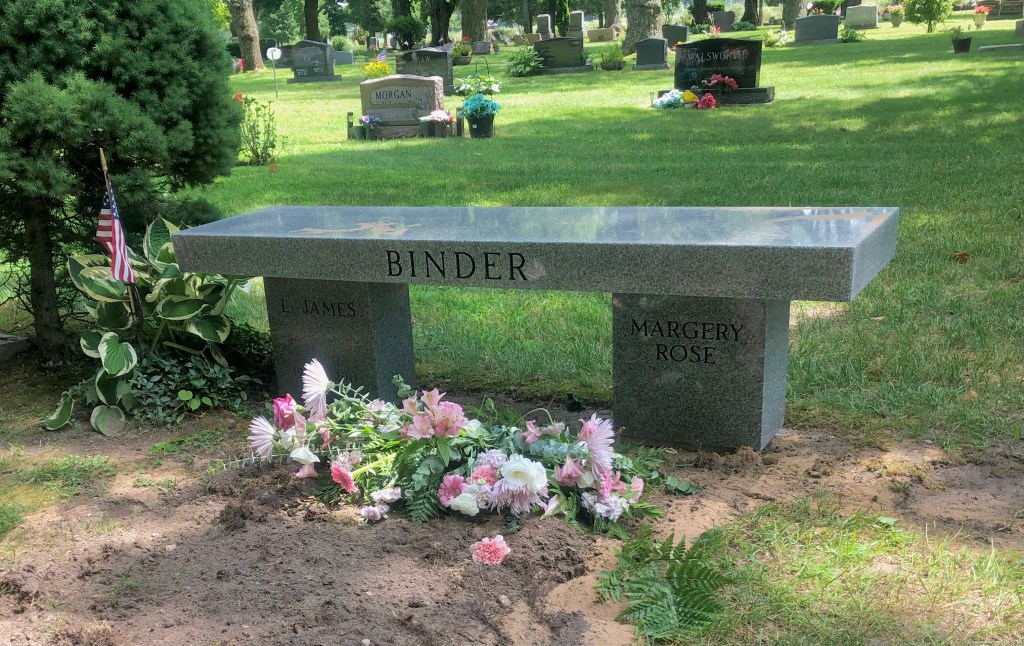
“May their memory be a blessing.” I get it. Because there is nothing else. Even so, some people treasure an urn full of ashes or a monument to visit. We visit Mom and Dad’s grave several times every summer. There’s a granite bench that Mom picked out and Mike designed. It was inspired by Dad’s reading of Midnight in the Garden of Good and Evil. He had remarked to Mom at the time about the parties that were held in the Savannah cemeteries; he liked that notion. Just this week we packed a picnic and some booze and hung out on the bench under the trees. Before we left, we dribbled some bourbon on the ground over Mom and vodka over Dad, along with a few olives. We did the same for a few other relatives in nearby plots. They’re not here, but their memory always will be. I can drink to that.
How and When
No one really gets a chance to choose, unless you’re facing capital punishment in some states. If I had my druthers, I’m all for passing quickly and peacefully. In my sleep would be nice. That always sounds easy but I’m thinking there is still a moment of awakeness, pain or panic. I doubt anyone wants to die violently or go down in a plane. And I’ve never encountered a person who’d like to suffer for months or years. Cruel.
As for timing, let me out of here before I lose my marbles. I’d prefer not to be institutionalized or a burden or a vegetable. That comes up a LOT more in conversations these days. Mary and I have broached the topic of our own deaths. No sense in avoiding the topic, as long as you don’t obsess about it. We’ve talked about “going to Portland,” our euphemism for euthanasia. But right now, we’re both good. So we choose to enjoy life.
Ashes to Ashes to…
There’s a lovely outdoor bar in Central Park near the Boathouse. It’s on a lake and it’s great for drinks and people watching. I was there one afternoon when a strong breeze blew south to north. The festive patio of the Boathouse Restaurant at the north end was crowded with the usual New Yorker glitterati, well-to-do out-of-towners and ladies who lunch, late.
From my perch, I watched as a gondola entered this arm of the lake from the south. There were three people on board: the oarsman in the middle, a priest of some Asian origin (a lama?) sitting astern and a woman kneeling near the bow. As the priest waved an incense burner and intoned a prayer, the lady in front began emptying the contents of the urn–ashes–into the water. Slowly at first and then with a bit more gusto.
From my vantage point, I could see that most of the ash cloud never hit the water. Instead it got caught up in the breeze, wafting a foot or two above the surface straight for the restaurant. The streaming cloud arrived on the patio, where the diners were oblivious. They had no idea death had arrived for a late lunch.
To recap and perhaps embellish this story: apparently the descedant and/or the grieving had made a plan that was spiritually inspired or legally mandated to rent a gondola and a priest on a beautiful day in New York City in order to deposit the cremains of a newly passed soul into a lake in Central Park that I assume was a treasured destination for the deceased.
What actually happened is that much of their essence ended up dusting an old fashioned, seasoning a chicken caesar and coating the crab cakes and remoulade dressing. Their remains were consumed, digested, maybe bused back to New Jersey or flown to Boise or Berlin. Out of discretion, respect and good taste (pun intended) I will leave it at that. But you get the idea.
Such is death. And life.


 Binderama60for60
Leave a comment